Making Things

Advertisements

Today is my car’s birthday. This day fifty four years ago on the 11th July 1966 my car rolled off the Ford production line at Dearborn, Michigan. USA.

1966. A Mustang hardtop coupe comes down the final assembly line at DAP.

Speaking of things being built, I was bought a model kit a while ago which was the LEGO GT500 kit, which I reviewed here. I thoroughly enjoyed it of course and wasted a good few hours making it. For my birthday (which was a good few months ago), I was bought another kit from my wife. I think it was to keep me quiet to be honest. This time it was a Technical kit which can cost between £75 and £150 depending on where you buy it. This kit is not an official LEGO kit but is pretty much identical to the real thing. I have done a full review of this kit here.

The kit is based on the official Hoonigan v2 made by LEGO with 3168 pieces. Model kits of this type differ in the fact it doesn’t rely on bricks, it relies on pegs and holes to fit together.

There is an option to be powered by motors and remote control which are purchased separately. An option I didn’t want to go for.

In the box was fourteen bags of parts, none of which were numbered like the Lego kits. There were bigger bags, the wheels, sheet of stickers, and then there were smaller bags of the pegs or fixings of different sizes and colours.

The instructions are not brilliant due to the fact that the print colours did vary a bit and the difference between the light grey and brown was difficult to spot on some pages.

There is a distinct pattern for the build as its cleverly build in a modular style. The smaller build part instructions are clear enough with arrows of what goes where. With the modular parts being added to the bigger build, it can be difficult to see where some bits are fitted together on the complex diagrams.

The model starts from the inside out, you build the differentials and gearing for the rear of the car. The diff then gets added to a bit of chassis which is ready for the next bit and so on.

As you build a part you can check the movement and operation. Little cogs marry up and are held by splines in part holes to allow it to move.

The rear suspension was fun and the way the whole section moves is very clever indeed. What starts out quite flimsy then with more parts it’s bolstered up and quite solid.

With the tunnel section completed in the middle the floor pans are added and all of a sudden the scale of the model becomes clear.

The build of the engine block has working pistons for you to see running off their own cam shaft.

The front suspension is complex and perhaps the hardest part of the model for me. Lining up the mini half shafts and gearing was a bit fiddly with my big hands. The curved sections are a long flexible spline that has tubes slid over it and the ends plugged into a termination point. Things like the headlights look great but can be easily dislodged, a little more on that later.

The fenders are built up to complete the look with the hood. The hood has a large cut out in the centre and does the frame of the hood a little fragile. Silver parts are added to the engine for the turbos and exhaust pipes.

The bag of silver parts some of which were obvious for the engine parts, the rest were for the seats sides and head rest. The steering wheel inside the car could in theory move the wheels, but it’s not strong enough for that and jumped a tooth or two on the cog, I had to jump it back again to centre the steering back up. But if you move the steering rack the steering inside the car will move fine.

The seats fit well into the car, but you have to be careful of the dash area not to dislodge the delicate steering joints.

The rear quarters are added and the wheel arches. Again these are twin flexible splines where the tiles are slid over and have to be even spaced out to look right. The fitting is plugged into termination pieces at each end and has to bend like a rainbow shape to fit. Give them a knock and they will come off which is very annoying.

Behind the seats is reinforced with more building. There is a silver part of the interior roll cage behind the drivers seat that attaches one end and just left to flap about inside.

This aggravated me and with some bits that were obviously going to be left over I made a little mod and attached it to a spare hole and attached it properly. Seen below with the left hand elbow joint. Also adding a little more stability.

The doors were straight forward enough, with a complex hinge mechanism which allows the door to open wide. The attachment to the rest of the car was more awkward as the one of the rubber bands that holds the doors shut pinged out of place which resulted in a deconstruction to refit the bands. Terrible idea I think as the band will perish and break leaving the doors to flap around at a later date.

The back of the car’s light panel gets built with lots of red and black thin bricks to make the tail lights. The result is a very effective and convincing light panel. Although no lights work on this car at all.

The trunk opens and closes with a hinge idea the same as the front hood.

The roof using the last of the long flexible splines threads the roof panels for the A pillars.

The front wheel arches are based on the same principle as the rears were and fitted into place, again not to a very secure fitting. But it does give a nice gentle curve with flat bricks.

The wheels were required to be fitted about two thirds of the way into the build. I kept knocking them off while turning the model over and around to work on different sections. So I fitted them as the last things on the car.

Once the model is built it does look really good and a pretty good representation of Ken Block’s Hoonigan v2.

Grievances I found with the model:

Wheel Hubs: A critical part of the ‘movable’ model. The wheel hubs; they are terrible. The wheels are held firmly in place to the hubs (brake discs) by three pegs. When you try to push the wheels into place the suspension moves and the tiny part of the UJ (universal Joint) that also has two little pins to turn the wheels from the gears pops out and there is no drive. If you are to power this model I promise you that the drive hubs will break loose on the front due to single point of fitting a UJ. This has to be the case as the wheels turn for the steering, rotate for the movement (using the two pins to stop it spinning within the hub), and to move up and down for the suspension. A three-way movement ball that is only a couple of millimetres wide at its widest part. I had to deconstruct the front end (twice until I learned my lesson), and some of the steering section to refit the part back onto the spline. The problem is that the spline is not long enough and allows a backward movement from the hub which should never happen. You could get round the spline movement by a blob of superglue to the UJ fitting end onto the spline.

Motorised Option: During the build for the suspension and the steering the motors instructions are an option. This will require a few tweaks to the construction. The motors will drive the rear wills via a diff and the front wheels via the second diff. The problem is that that the splines and cogs are a bit to delicate for my liking.

There is a super clever option to allow the car to ‘drift’ under it’s own power by a configuration of the diff. I have no idea how fast these motors are supposed to go. But guessing there is a drift option it should have a fair amount of speed to move the model.

Decals: These are cheap and obviously don’t say the correct branding due to the copy right. It’s very clever how the use of fonts and slight rearranging of characters can lead you to misread it as you know what it should say. The decals are not the water based style which leaves very little visible evidence of the background or clear parts. These stickers are self adhesive and clearly show on the black bricks of the model. The air bubbles are a nightmare and ruin the smooth outline. The decals are not cut correctly for some parts that go over some raised surfaces, such as the ford logo on the front, a sharp scalpel to cat the deal to allow it to lay flatter makes a big difference. An option is to even leave the stickers off the car. It will still look great.

These cheap decals seriously lets the model down for me unfortunately.

Tyres & Rims: The just slip over the rims and can be moved on the rims once fitted. I suspect that a bit of serious drifting will dislodge the tyres on the rims. This can be cured of course by a few well placed blobs of super glue to hold the tyres to the rims. But if you scrub the rather thin tyres out it will become a nightmare to replace them. The rims themselves don’t actually look like the real car! Something to do with copyright maybe I don’t know. But it’s a bit of big ‘error’.

Doors: The hinges are helped to stay shut via twisted elastic bands. Give it time like I mentioned above the bands will perish and the doors won’t stay shut if under it’s own power. They will probably fly open and shut depending on where it goes I guess.

Build Quality: Some of the parts will be knocked of and dislodged fairly easily, such as the headlights, front air splitter, the turbo parts of the engine and wheel arches in particular. Nothing which a bit of superglue wouldn’t sort out.

There are two options for the model and the static option looks great in a cabinet for display. The model is large and heavy. Trying to push the vehicle along will hear all sorts of teeth jumping and the engine pistons (which you can’t see anyway with the hood down) in particular getting stuck.

If you are going to motorise this then you need to beef it up with some superglue! The wheel hubs will dislocate from the centre of the wheels, this can be easily done by just pushing the car along, or trying to turn the wheels on steering lock.

The underside of the car has cut outs for the cogs, this allows for dirt and debris to contaminate the meshing of the cogs and will cause problems.

As the sales blurb says itself; “It is not really a toy, but rather a model for the showcase”.

The majority of the car is a real fun build and took me many hours to complete. There were no parts missing and all the parts fitted together correctly. The kit is indeed a challenge to build and I liked that. It sounds like a I had a downer on the model, but I actually don’t. If the model is left alone it will look great.

Now I have completed this model I need to look for the next one, quite where I’m going to put them is a challenge as well. The model is a lot of money and I hope it gives a rough idea of what it’s like as a model and to build it before maybe buying it.

Keep safe and take care.

Error happened.
Share my Content

Lockdown

Advertisements

So here I am under government instructions to stay at home to stem the spread of the Covid19, as is the rest of the country. Some are taking this enforced lockdown more seriously than others I might add. All the car shows I had lined up to go to and have been looking forward to have been cancelled, I can accept that if it’s short term, as long as I can at least get a few in before the end of the year. But what can you do in the mean time? To while away the time I have just finished my mini project which I was going to make last when I have a little time over the weekends. Now I have more time than I actually planned for. So not only have I completed my project, I have written about it too. You will be pleased to know that it’s Mustang related of course, but in the form of Lego. So if you were wondering is it worth it and what’s involved let me explain;

The Sales Pitch from : Lego

Discover the magic of an iconic 1960s American muscle car with the LEGO® Creator Ford Mustang, featuring dark-blue bodywork with white racing stripes, bonnet scoop, printed mustang grille badge, GT emblems and 5-spoke rims with road-gripping tires. Developed with input from Ford, this authentic replica comes with optional add-ons for customization, including a selection of license plates, supercharger, rear ducktail spoiler, beefy exhaust pipes, front chin spoiler and a nitrous oxide tank. You can even adjust the lift of the rear axle for an extra-mean look! Remove the roof panel or open the doors and you have access to the detailed interior with handsome seats, radio, working steering and a mid-console gearshift. Store items in the trunk or lift the hood to reveal a detailed big block 390 V8 engine with battery, hoses and air filter detailing. This advanced building set has been designed to provide a challenging and rewarding building experience full of nostalgia and makes a great centerpiece for the home or office.

– Authentic replica of a 1960s Ford Mustang featuring dark-blue bodywork with white racing stripes, air scoop, 5-spoke rims with road-gripping tires, and a selection customization add-ons.

– Open the doors or remove the roof panel to access the detailed interior with handsome seats, radio, mid-console gearshift and working steering.

– Open the trunk to store items and lift the hood to reveal a detailed Ford Mustang V8 engine with battery, hoses and air filter.

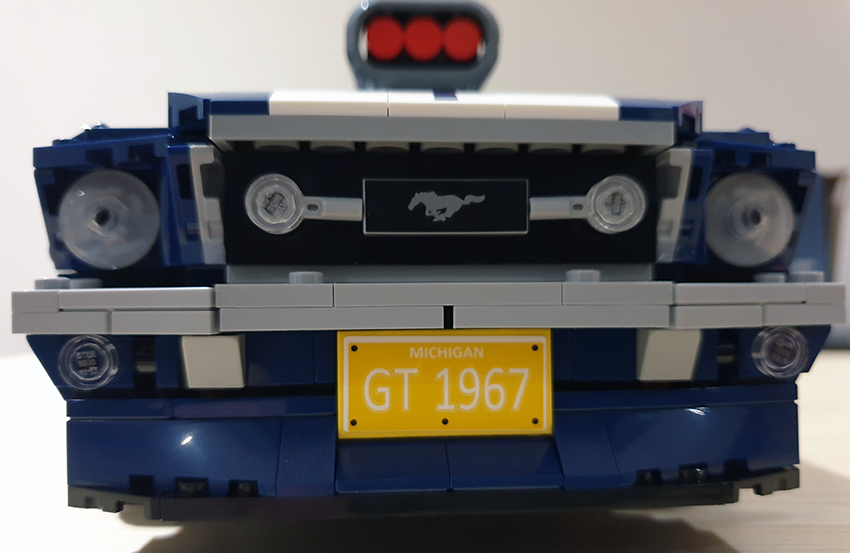
– Includes a printed mustang grille badge and 2 GT emblems.

– Customize the Ford Mustang with the included supercharger, rear ducktail spoiler, beefy exhaust pipes, front chin spoiler and a nitrous oxide tank.

– Choose from a selection of license plates.

– Lift the hood to check out the realistic engine detailing.

– Adjust the lift of the rear axle for a real mean look!

– New-for-March-2019 special elements include 5-spoke rims, 2×8 brick with bow, 1×3 mustang logo tile, 2×4 bow with ‘GT’ Emblem.

Measures over 3” (10cm) high, 13” (34cm) long and 5” (14cm) wide.

Source:  https://www.lego.com/en-gb/product/ford-mustang-10265

What You Get:

You get a big box and a lot of smaller plastic bags inside, an instruction manual and a sticker sheet.

What’s In The Box?

You get eleven plastic bags of parts although they are labelled as one to six with all but bag five having a smaller bag with the same number. A total of 1471 parts for you to try and sort out.

TIP:

Don’t open all the bags at once, only open what you need!

Instructions:

The instruction book starts with a brief background to Ford and the Mustang with time lines. A nice little addition it must be said.

The start of the instructions tells you which packets to use for which section build.

The instructions are all diagram based with the parts you need counted out and shown to you before assembly. Where the similar looking parts and colours are used the instructions has a 1:1 check to make sure you get the correct part. Some of the differences are very subtle.

Building the Model

This is the first time I have touched Lego in about forty five years or so. Oh how it’s moved on. The tolerances are still perfect, things fit together and don’t fall apart. A huge leap forward to building cars and houses when I first played with it and stood on the bricks!

The hours just rush by when building this. I challenge anybody to spend only what they think is an hour doing a build without anything to tell you the time. When you think it’s been an hour it’s a lot more than that. I found it addictive to do a page, then think ‘I will quickly do that bit as well’, it draws you in.

You start at the back of the car building the suspension, lots of little cogs seem to be placed for no apparent reason, then a few pages later it suddenly comes together. The sense of achievement is well thought out and makes you want to come back for more.

I found it easier to get all the parts I would be using for that little build located into an area to save looking for the parts as I went along, which I found could delay my build of that little section. Find it, collate it, then build it and repeat. No matter how you do it, the whole process is enjoyable. It actually started to upset my OCD in the end and I had to line the bits up I was about to use and separate into little bub piles of parts.

Next you move to the middle of the car for the transmission tunnel, adding the gear shift, radio and dials to the bricks. Parts seem to be built modular style then applied to the overall model itself.

Steering and engine next, considering the level of detail in this model I found my first grump. The engine only has four spark plug leads. They could of made it eight and just gave it that little bit extra detail.

Nice detail touches on the engine due to the name and the oil cap etc.

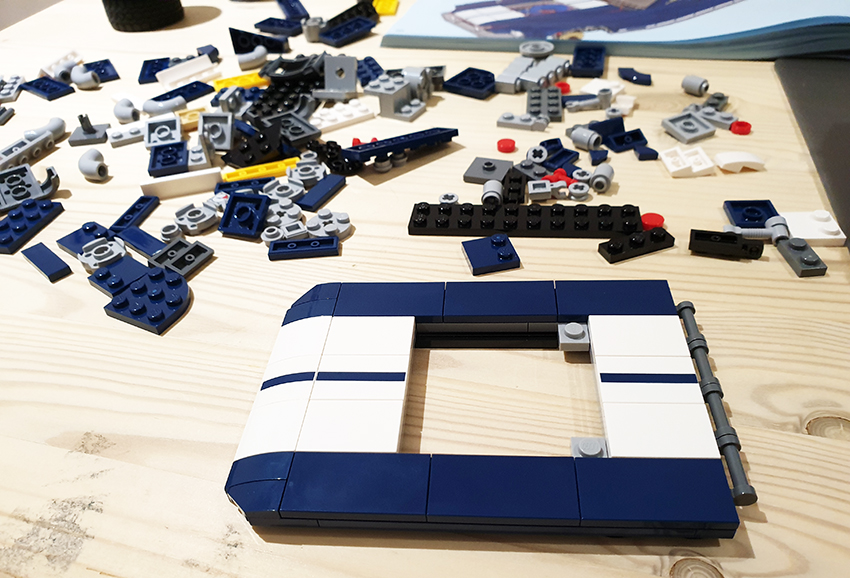
Building the body work is interesting how it comes together.

The door hinges caught me out as I had a little bit round the wrong way. The supplied brick separating tool is great and saves digging your fingernails between the bricks.

The design of the model has taken a lot into account for the assembly. They get you to place some round white bricks under the front corners of the car. When you press the bricks onto the model, these corner blocks means that it doesn’t flex or come apart when you add the little sub sections of build. When the car is finished the round white bricks are then removed, fitted together to make the NOS bottle for the trunk, providing you want that of course. How cool is that to reuse bricks in order to make your build journey enjoyable?

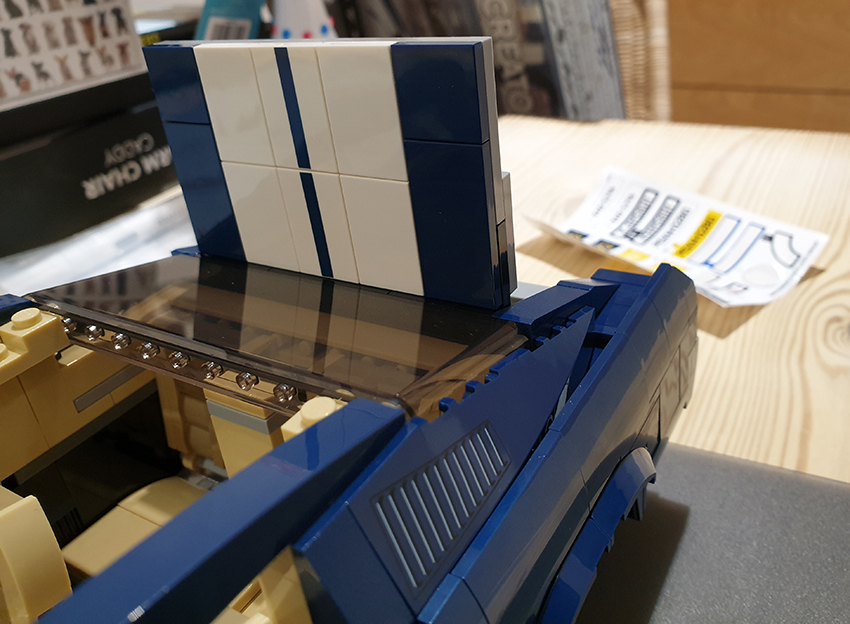
Just like restoring a real car, seeing the seats go in and the rear ‘glass’ starts to show the model is nearing completion. The hood offers the option for the stock scoop look or the opening for the super charger. It doesn’t matter if you change your mind later, it only takes around five seconds to swap it over.

The roof is designed to be a single section so it’s easy to remove and see the detail inside the model.

The other options for the model are the side pipes, front spoiler, rear spoiler and NOS bottle.

The completed model looks just as mean as the real thing.

I mentioned earlier about the two engine options; the standard or the hot rod version. The super charger will poke out the opening in the hood, or use the stock pan and the scoop. I built both just because I could and can swap them as I want.

The Super charger option works well and looks in proportion to the rest of the car.

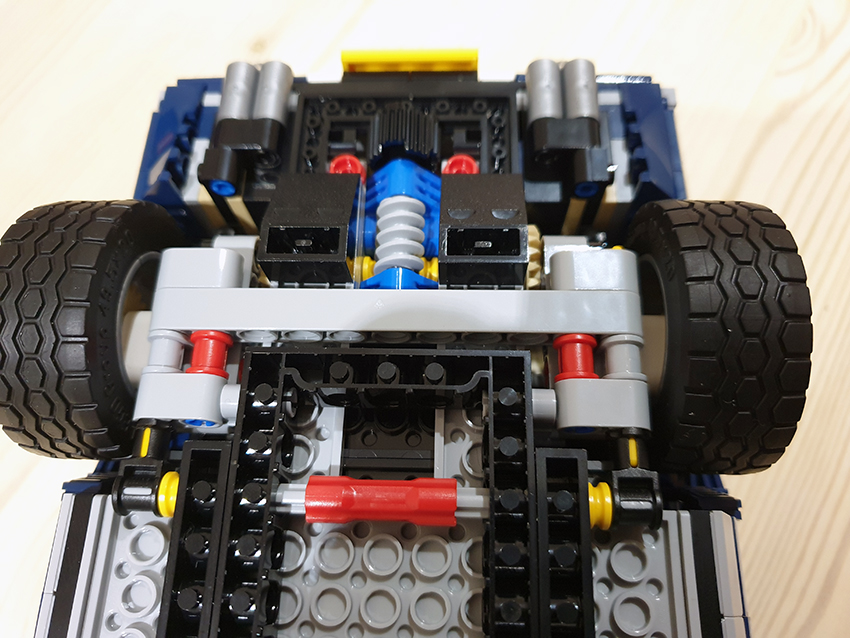
The underside of the model shows the level of detail you can’t see, it also allows access to the thumb adjustable wheel to raise up the back of the car’s stance.

The completed model looks quality and withstands being handled without falling apart.

There is a third party option to add LED lights to the model. It does involve some disassembly, but the instructions and video show you how to do that and only take fifteen minutes or so to upgrade. If you want your car to be on show with the lights then it could be worth fitting that kit at the same time to save a bit of hassle later.

Results:

An amazing model and sits nicely with my other model. I need to get a little case for this one as well I think

It was a joy to make, and is a pleasure to look at. The parts are real top quality as you expect from genuine Lego kits, everything just works together. I had no missing parts and everything was there.

Rating:  9 out 10

An excellent model as I said, but there was just the number of spark plug wires that let the detail aspect down a bit as a model for me.

The instructions are very good indeed and well paced, the printing was fine and clear. The colour definition between the lighter coloured parts could be confusing and I would liked to have seen a bit more colour definition. Those are the only two reasons I marked it down.

Ease of use – 8 out 10

Finish – 10 out 10

Conclusion:

A lot of money for a Lego kit, but I was impressed. On the other hand you do get a lot of good quality model for that money. The price may put this kit out of reach for many to buy and build. As with all things Lego the price seems to stay put and not vary much.

The age range to start this is suggested at 16+ which I personally think is a little harsh, perhaps a petrol headed 14 year old into cars would like it, 15 years old on should be fine. Sometimes the small fingers do help, rather than my big hands getting in the way. This build will keep you quiet for a good few hours either as a young adult or a middle aged man like me.

The instructions take you on a journey that you’re not aware of, and completing each little bit leads gives you a sense of achievement enough to make you want to complete the next section. The Lego look with the little bumps and strange lines works well on the model and certainly doesn’t detract from the over all look. You can see it’s Lego and will appreciate that somebody has gone to good lengths to complete it and enjoyed it at the same time.

When it was finished I was a bit gutted that I didn’t have any more to build to be honest.

Would I recommend it? Yes. But, it’s expensive.

So there you have it, a good many hours spent working on a Mustang, all be it a much smaller, modular version of the real thing. I will be writing some more car detailing reviews soon, so keep an eye out for those. If I can’t drive my my car at least I can still clean it, even though it’s already clean. It also keeps me out of the way being indoors with the wife. The more I get under her feet the more she will find me “jobs” to do. She is trying to teach me to cook as well, me and kitchens don’t go well it has to be said. Yet when I try and get her to clean, polish, wax and detail her own car, the same levels of (non) enthusiasm I showed to cooking is reciprocated and more.

I do know that my time is already being allocated to redecorating the house, even though it did some of it just over a year ago. I have spotted the delivery of a few large tins of paint. So I need to keep busy, keep scarce in order to put off the the job that I seriously detest – decorating.

I think I need to get another model though to keep me quiet in these unprecedented times of forced isolation. Or I may end up cleaning walls and applying paint rather than applying extra layers of top quality wax to my pride and joy. Who am trying to kid? It’s not if if decorate, it’s a case of when!

Error happened.
Share my Content